

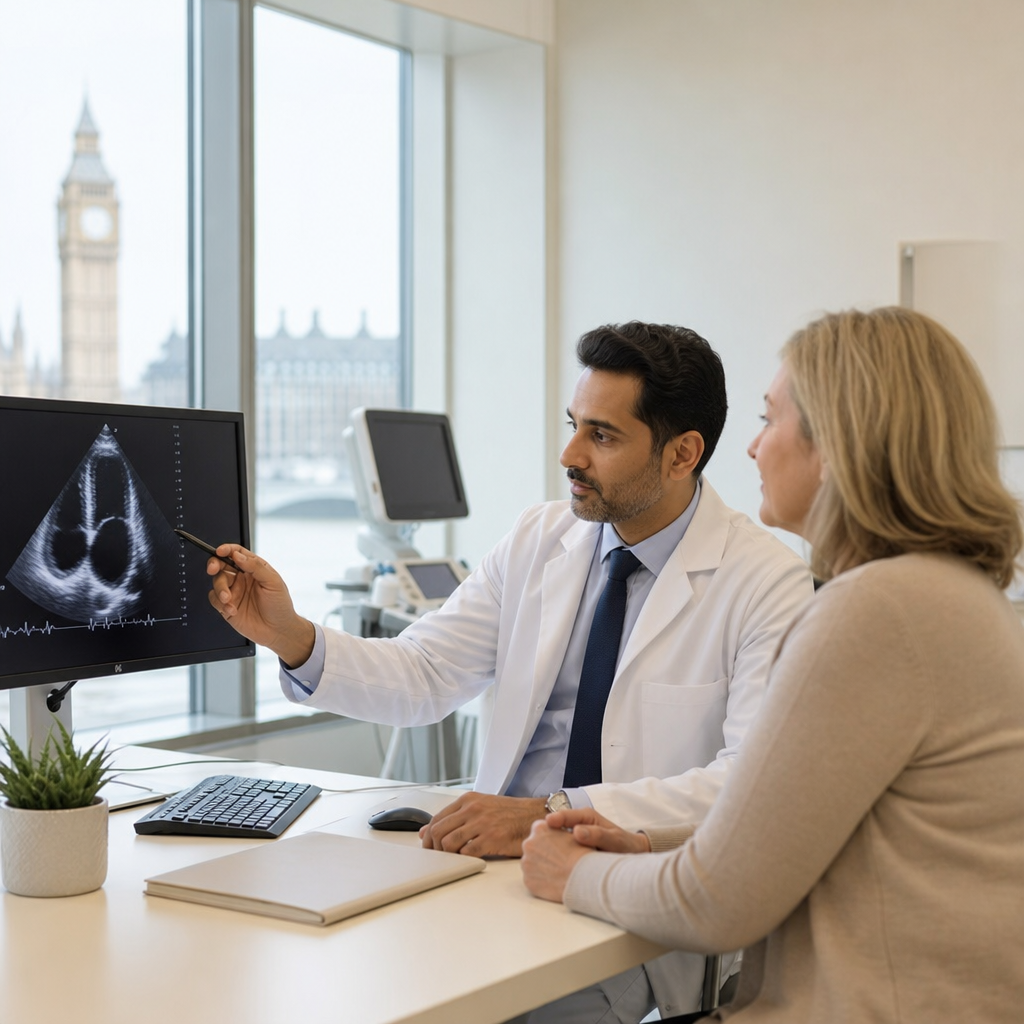
Choosing a heart test is not simply a matter of picking the most advanced scan. The right investigation depends on your symptoms, medical history and the question your cardiologist needs to answer. This practical guide to cardiology tests available privately in London explains what common investigations can show, what to expect and how results may guide the next step. For a closer look at two common investigations, read our guide to private ECG and echocardiogram in London.
Dr Chabok provides cardiology consultations, diagnosis and treatment, including heart investigations and interventional procedures. Clinics are listed in London and Harefield; ask the practice which tests are appropriate and where they can be arranged. Not every test is suitable for every person, and a consultation may be needed to decide what is useful. Our guide to choosing the right cardiology test explains how symptoms can help inform which investigation may be appropriate.
Start with the clinical question, not the test
Cardiac investigations are designed to look for different things. Some record the heart’s electrical activity, some assess its structure and pumping function, and others examine blood pressure, rhythm over time or the coronary arteries. A normal result on one type of test does not necessarily answer every heart-health question. Learn more about heart health checks in London, including how ECGs and echocardiograms may fit into an assessment.
For example, a resting ECG is a brief snapshot of electrical activity. It may not capture an intermittent palpitation that happens only once every few days. In that situation, a longer rhythm recording may be more informative. Likewise, an echocardiogram can assess heart structure and function, but it does not directly show every narrowing in the coronary arteries. If you are considering tests because of chest discomfort, see our guide to chest pain assessment with a London cardiologist.
A cardiologist can use your symptoms, examination and risk factors to decide whether testing is needed, which investigation is most relevant and whether one test should come before another.
Common private cardiology tests in London
Consultation and clinical assessment
A consultation is often the starting point. Your cardiologist may ask when symptoms occur, how long they last, what brings them on and whether anything relieves them. They may also review your medical and family history, medicines and previous test results. Blood pressure, pulse and a physical examination can help put the symptoms in context.
Bring a list of medicines and any relevant letters or investigation reports. If symptoms are intermittent, a brief note of when they happen and what you were doing can also be useful.
12-lead electrocardiogram (ECG)
An ECG records the heart’s electrical signals using electrodes placed on the skin. It is quick and does not involve needles or radiation. It can help identify certain rhythm or conduction abnormalities and may show patterns that prompt further assessment.
Because it records only a short period, an ECG may not detect a rhythm problem that is not happening during the test. It is often interpreted alongside your symptoms and other findings rather than used as a stand-alone reassurance.
Echocardiogram
An echocardiogram uses ultrasound to create moving images of the heart. It can assess the heart’s chambers, pumping action, valves and blood flow. A standard transthoracic echocardiogram is performed with a probe moved over the chest and does not use ionising radiation.
Your clinician may recommend an echo when assessing breathlessness, a murmur, suspected valve disease or possible changes in heart function. The test provides structural and functional information, but it is not the same as imaging the coronary arteries.
Ambulatory ECG monitoring
Ambulatory monitoring records heart rhythm while you go about your usual activities. Depending on the type of monitor and the clinical question, recording may last from a day to longer. It can help investigate palpitations, episodes of dizziness or suspected rhythm disturbances that may not appear during a clinic ECG.
You may be asked to keep a diary of symptoms and activities so the cardiologist can compare them with the recording. Ask how to wear the device, whether it can get wet and what to do if symptoms occur.
Blood pressure monitoring
A clinic reading is one measurement taken at a particular time. Ambulatory blood pressure monitoring uses a wearable cuff to take repeated readings during the day and, where arranged, overnight. This can help build a broader picture of blood pressure beyond a single appointment.
Your clinician may also ask you to record home readings. Follow the instructions provided, as cuff fit, timing and how you sit can affect readings. Do not change prescribed blood pressure medicine based on an isolated result without medical advice.
Exercise ECG and stress echocardiography
An exercise ECG records electrical activity while you walk on a treadmill or use another exercise protocol. It may be considered when a clinician wants to assess how the heart responds to exertion. It is not appropriate for everyone, and the cardiologist will consider your health and ability to exercise before recommending it.
Stress echocardiography combines ultrasound images with a form of stress, commonly exercise or medication. It assesses how the heart muscle works under increased demand. The exact protocol and suitability depend on your circumstances, so ask what preparation is required and what alternatives might be considered.
Coronary CT angiography
Coronary CT angiography (CTCA) uses a CT scanner and contrast dye to produce images of the coronary arteries. It may be used to assess suspected coronary artery disease when a clinician considers it suitable. It involves ionising radiation, and the contrast dye and your kidney function, allergies and other health factors may need to be considered.
CTCA is different from an invasive coronary angiogram. If a scan shows a finding that needs further assessment, your cardiologist will explain what it means and whether additional tests or treatment should be discussed.
Cardiac MRI and invasive coronary angiography
Cardiac MRI uses magnetic fields to produce detailed images of the heart. It can help assess aspects of heart structure, function and tissue characteristics. Whether it is useful depends on the clinical question, and some implants or health circumstances may affect suitability.
An invasive coronary angiogram is a procedure in which a catheter is guided through an artery and contrast dye is used to image the coronary arteries. It is not usually the first test for every person with chest symptoms. In selected cases, it can help clarify a diagnosis and inform treatment planning. If a significant narrowing is found, options may include medication, further discussion or an interventional procedure such as angioplasty and stenting, depending on the individual assessment.
How a cardiologist may choose your investigation
- Define the concern. Is the main issue chest discomfort, palpitations, breathlessness, blood pressure or a previously identified condition?
- Review context. Your history, examination, medicines and previous results help determine which tests may add useful information.
- Match the test to the question. Rhythm monitoring, ultrasound and coronary imaging answer different questions; more tests are not automatically better.
- Discuss preparation and limitations. Ask about timing, medicines, contrast, radiation, exercise requirements and when results will be reviewed.
- Agree what happens next. The result may lead to reassurance, monitoring, treatment or another investigation. Your clinician should explain the plan in the context of your symptoms.
What to ask before booking a private heart test
- What specific question is this test intended to answer?
- Do I need a consultation or a referral before it is arranged?
- Where is the test performed, and what preparation is needed?
- Should I continue my regular medicines as usual?
- Who will explain the result, and how will it affect my care plan?
- If the test is not suitable or does not explain my symptoms, what may be considered next?
Private testing can offer a route to specialist assessment, but the value comes from choosing an investigation for a clear clinical reason and having the result interpreted by a qualified clinician. A test report should be considered alongside your symptoms and medical history.
When to seek urgent help
Do not wait for a private appointment if you may be having a medical emergency. Call 999 for severe or persistent chest pain, especially if it spreads to your arm, back, neck or jaw, or occurs with breathlessness, sweating, nausea or collapse. For urgent but non-emergency concerns, use NHS 111 or seek appropriate medical advice.
Frequently Asked Questions
What cardiology tests are available privately in London?
Depending on the clinical need and local arrangements, private cardiology assessment may include an ECG, echocardiogram, rhythm monitoring, blood pressure monitoring, exercise testing, coronary CT angiography, cardiac MRI or invasive coronary angiography. A cardiologist can advise which is appropriate.
Can I book a heart test without seeing a cardiologist?
Requirements vary by test and provider. Some investigations need a clinician’s assessment first so that the test is suitable, properly prepared for and interpreted in context. Ask the practice about its process before booking.
Which test is best for palpitations?
It depends on how often the palpitations occur and what other symptoms you have. A clinic ECG may be useful, while ambulatory ECG monitoring may be considered when symptoms are intermittent. Your clinician will decide whether other assessment is needed.
Does an echocardiogram show blocked coronary arteries?
A standard echocardiogram assesses heart structure, valves and pumping function; it does not directly image the coronary arteries. Other investigations may be considered if the clinical question concerns coronary artery disease.
How should I prepare for a private cardiology test?
Preparation varies. You may need to follow instructions about food, drink, medicines, exercise or clothing, particularly for some imaging or stress tests. Confirm the instructions with the provider and do not stop prescribed medication unless a clinician tells you to.
Frequently Asked Questions
What cardiology tests are available privately in London?
Depending on the clinical need and local arrangements, private cardiology assessment may include an ECG, echocardiogram, rhythm monitoring, blood pressure monitoring, exercise testing, coronary CT angiography, cardiac MRI or invasive coronary angiography. A cardiologist can advise which is appropriate.
Can I book a heart test without seeing a cardiologist?
Requirements vary by test and provider. Some investigations need a clinician’s assessment first so that the test is suitable, properly prepared for and interpreted in context. Ask the practice about its process before booking.
Which test is best for palpitations?
It depends on how often the palpitations occur and what other symptoms you have. A clinic ECG may be useful, while ambulatory ECG monitoring may be considered when symptoms are intermittent. Your clinician will decide whether other assessment is needed.
Does an echocardiogram show blocked coronary arteries?
A standard echocardiogram assesses heart structure, valves and pumping function; it does not directly image the coronary arteries. Other investigations may be considered if the clinical question concerns coronary artery disease.
How should I prepare for a private cardiology test?
Preparation varies. You may need to follow instructions about food, drink, medicines, exercise or clothing, particularly for some imaging or stress tests. Confirm the instructions with the provider and do not stop prescribed medication unless a clinician tells you to.