

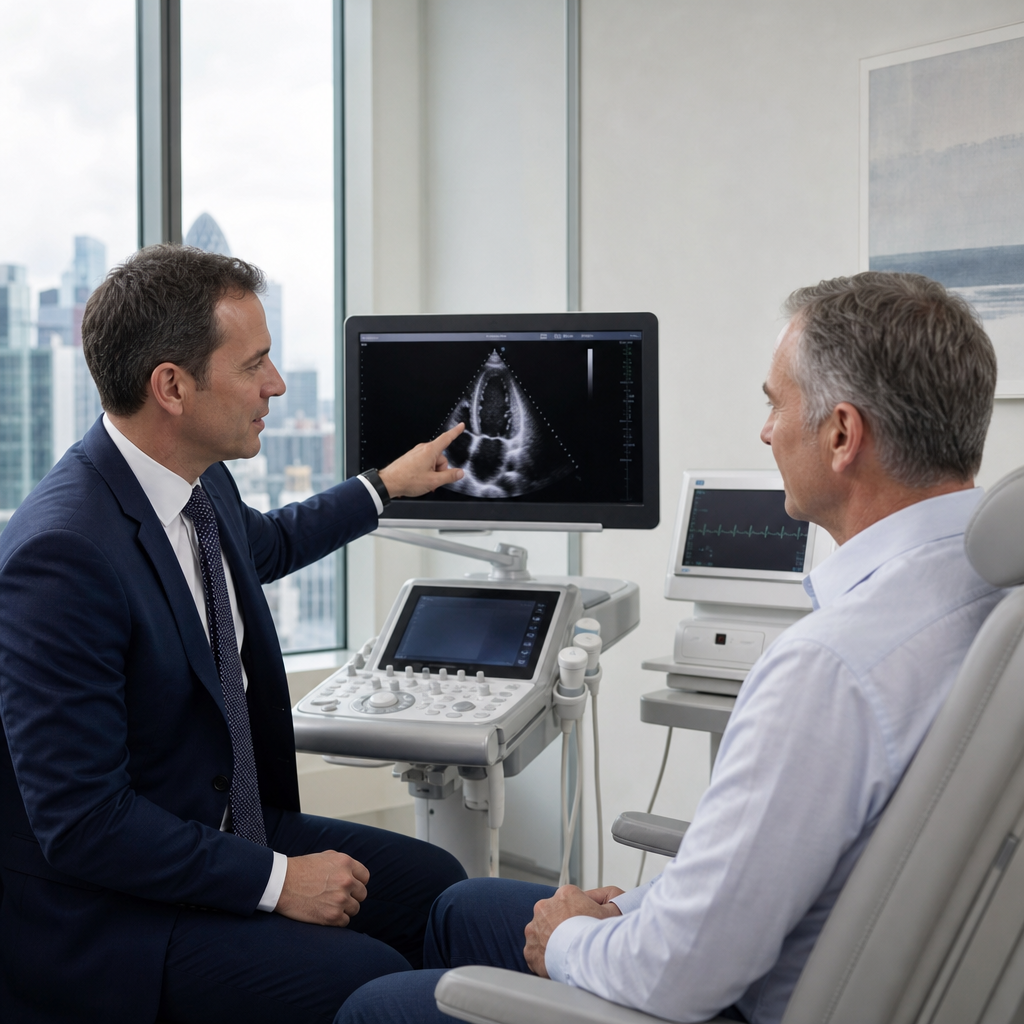
Searching for cardiology tests available privately in London can bring up a long list of investigations. But a test is not automatically useful just because it is available. The right choice depends on your symptoms, medical history, examination and what your cardiologist needs to find out. If you are unsure which investigation fits your symptoms, read our guide to choosing the right cardiology test.
This practical guide explains common heart investigations, from an ECG and echocardiogram to heart rhythm monitoring and coronary imaging. It also covers how a private cardiology consultation can help put results into context. The aim is not to self-diagnose or select a test from a menu, but to understand what each investigation may contribute to a care plan. For a closer look at two common investigations, see our guide to a private ECG and echocardiogram in London.
Start with the question, not the test
Different tests look at different aspects of the heart. Some record its electrical activity; others assess its structure, pumping action, rhythm over time or blood supply. No single investigation can answer every question, and a normal result does not necessarily rule out every heart condition. Our guide explains what to expect at a heart check-up with a London cardiologist.
At a consultation, a cardiologist will usually ask about symptoms such as chest discomfort, breathlessness, palpitations, dizziness or fainting. They may also review your medical history, medicines, family history and risk factors such as high blood pressure. This information helps determine whether a test is appropriate and which one is likely to be informative. You can also read about what happens at a cardiology consultation before tests are recommended.
Common private cardiology tests and what they show
Electrocardiogram (ECG)
An ECG records the heart’s electrical activity using small sensors placed on the skin. A standard resting ECG takes only a short time and can show the heart rate and rhythm at that moment. It may also provide clues that prompt further assessment.
Because it is a brief snapshot, an ECG may not capture an intermittent rhythm problem or explain every episode of chest pain. Your cardiologist may suggest monitoring over a longer period if symptoms come and go.
Echocardiogram
An echocardiogram, often called an echo, is an ultrasound scan of the heart. It can assess the size and movement of the heart chambers, how well the heart pumps and how the valves are working. It does not use ionising radiation.
An echo is useful for assessing heart structure and function, but it is not a general test for every cause of chest pain or palpitations. The type of scan and whether further imaging is needed depend on the clinical question.
Ambulatory heart rhythm monitoring
If palpitations or other symptoms are intermittent, a cardiologist may recommend a portable ECG monitor. Depending on the device and the pattern of symptoms, monitoring may last from a day to longer. You may be asked to record when symptoms occur so the clinician can compare them with the heart rhythm.
Longer monitoring can improve the chance of recording an occasional episode, but it cannot guarantee that symptoms will happen during the recording period. The most suitable monitor depends on how often symptoms occur and the information needed.
Blood pressure monitoring
Blood pressure can vary during the day and may be affected by activity, stress or the setting in which it is measured. Ambulatory blood pressure monitoring uses a wearable cuff to take readings at intervals over a period, often including day and night. This can help a clinician assess patterns outside a single appointment.
Your doctor may also recommend home readings, depending on your circumstances. Do not change prescribed blood pressure medication based on isolated readings without discussing it with a healthcare professional.
Exercise testing and stress imaging
An exercise test records information such as ECG changes, heart rate and symptoms while you exercise under clinical supervision. It may be considered when a clinician wants to assess how the heart responds to exertion. It is not suitable for everyone, and it does not provide a complete picture of coronary arteries.
In some situations, stress imaging may be considered instead of, or alongside, an exercise ECG. These investigations assess the heart under stress using imaging techniques. The choice depends on your symptoms, ability to exercise, medical history and the specific question being investigated.
CT coronary angiography and calcium scoring
CT coronary angiography uses a CT scanner and contrast material to create images of the coronary arteries, which supply blood to the heart. It may be used to assess whether there is narrowing in these arteries when clinically appropriate. It involves radiation and contrast, so suitability should be discussed with a clinician.
A coronary artery calcium score is a different CT-based assessment. It looks for calcium in the coronary arteries and may help with risk assessment in selected circumstances. It does not show the arteries in the same way as CT coronary angiography, and it is not the right test for every person with chest symptoms.
Cardiac MRI
A cardiac MRI uses magnetic fields to produce detailed images of the heart. It can help assess heart structure, function and, in some cases, tissue characteristics. It may be considered when an echocardiogram or other assessment has not answered a particular question, or when more detailed imaging is needed.
An MRI is not suitable for everyone, and you will be asked about relevant implants, devices and other safety considerations. Your clinician can explain what the scan may add in your case.
Blood tests
Blood tests can support a heart assessment by checking for issues that may affect symptoms or cardiovascular health. The tests requested depend on the situation: there is no single blood test that can diagnose every heart condition. For new or severe symptoms, urgent assessment may be more important than arranging routine private tests.
How a private cardiology assessment can guide testing
A private consultation can help connect symptoms with the most appropriate next step. At Dr. Chabok’s cardiology clinics in London and Harefield, assessment and treatment may include heart investigations, with further care considered according to clinical findings. Where coronary heart disease is identified, management can range from advice and medication to further assessment or an interventional procedure such as angioplasty and stenting, if appropriate.
Availability of individual tests, appointment arrangements and the pathway after testing can vary between clinics. Ask which investigation is being proposed, what question it is intended to answer, how you will receive the result and what may happen next. A test result should be interpreted alongside your symptoms and medical history, not in isolation.
Preparing for a cardiology test
Preparation varies by investigation. When booking or receiving instructions, check whether you need to avoid food or drink, adjust any medicines, wear particular clothing or bring previous test results. Do not stop medication unless a clinician has specifically advised you to do so.
- Bring an up-to-date list of medicines and relevant medical history.
- Note when symptoms occur, how long they last and what seems to trigger them.
- Ask whether the test involves exercise, contrast material or radiation.
- Find out how and when results will be discussed, and who to contact with questions.
When to seek urgent help
Private outpatient testing is not a substitute for emergency care. If you have severe or persistent chest pain, serious difficulty breathing, collapse, or symptoms that could indicate a heart attack or another emergency, call 999 or go to an emergency department. Do not wait for a routine appointment or test.
Frequently Asked Questions
Which cardiology test is best for palpitations?
It depends on how often the palpitations happen and what the initial assessment shows. An ECG may be followed by ambulatory rhythm monitoring if symptoms are intermittent. A cardiologist can advise which monitoring period and device are suitable.
Can a normal ECG rule out heart disease?
No. A resting ECG records electrical activity over a short period and may not show intermittent rhythm changes or every cause of chest symptoms. Your clinician may consider other tests based on your symptoms and examination.
Do private cardiology tests require a referral?
Referral arrangements vary between providers and clinics. Contact the clinic to check what is needed to book an assessment and whether any previous records or test results should be sent ahead.
How quickly will I get my test results?
Timing depends on the investigation, clinic arrangements and whether specialist interpretation is needed. Ask when booking how results will be communicated and whether a follow-up consultation is included or needs to be arranged separately.
Can I choose a heart test without seeing a cardiologist?
Some services may offer tests through different routes, but a clinician’s assessment helps establish whether a test is appropriate and how to interpret its result. Choosing an investigation without clinical context may not answer the concern you have.
Are private heart tests suitable for an emergency?
No. Private outpatient investigations are arranged for planned assessment, not to manage a medical emergency. For severe or persistent chest pain, collapse or serious breathing difficulty, call 999.
This article provides general information and is not a substitute for an individual medical assessment or treatment advice.
Frequently Asked Questions
Which cardiology test is best for palpitations?
It depends on how often the palpitations happen and what the initial assessment shows. An ECG may be followed by ambulatory rhythm monitoring if symptoms are intermittent. A cardiologist can advise which monitoring period and device are suitable.
Can a normal ECG rule out heart disease?
No. A resting ECG records electrical activity over a short period and may not show intermittent rhythm changes or every cause of chest symptoms. Your clinician may consider other tests based on your symptoms and examination.
Do private cardiology tests require a referral?
Referral arrangements vary between providers and clinics. Contact the clinic to check what is needed to book an assessment and whether any previous records or test results should be sent ahead.
How quickly will I get my test results?
Timing depends on the investigation, clinic arrangements and whether specialist interpretation is needed. Ask when booking how results will be communicated and whether a follow-up consultation is included or needs to be arranged separately.
Can I choose a heart test without seeing a cardiologist?
Some services may offer tests through different routes, but a clinician’s assessment helps establish whether a test is appropriate and how to interpret its result. Choosing an investigation without clinical context may not answer the concern you have.
Are private heart tests suitable for an emergency?
No. Private outpatient investigations are arranged for planned assessment, not to manage a medical emergency. For severe or persistent chest pain, collapse or serious breathing difficulty, call 999.